
The Core - Risk Adjusted Efficiency

TL;DR
I run a core portfolio policy that automatically rebalances a diversified portfolio using my own platform. Rebalance events are triggered by relative and ATR-based bands. The approach is tax efficient - I never sell an entire position - and it keeps drawdowns low, producing good risk-adjusted returns on the core portfolio that backs my premium-selling strategies. Over the backtest window below it compounds at 15% a year against a 6.6% max drawdown - MAR 2.30, Sharpe 1.73, Sortino 1.61 - on about 6 rebalance events a year.
The backtest shows the overlapping window available across all assets used (since 11/01/2024)
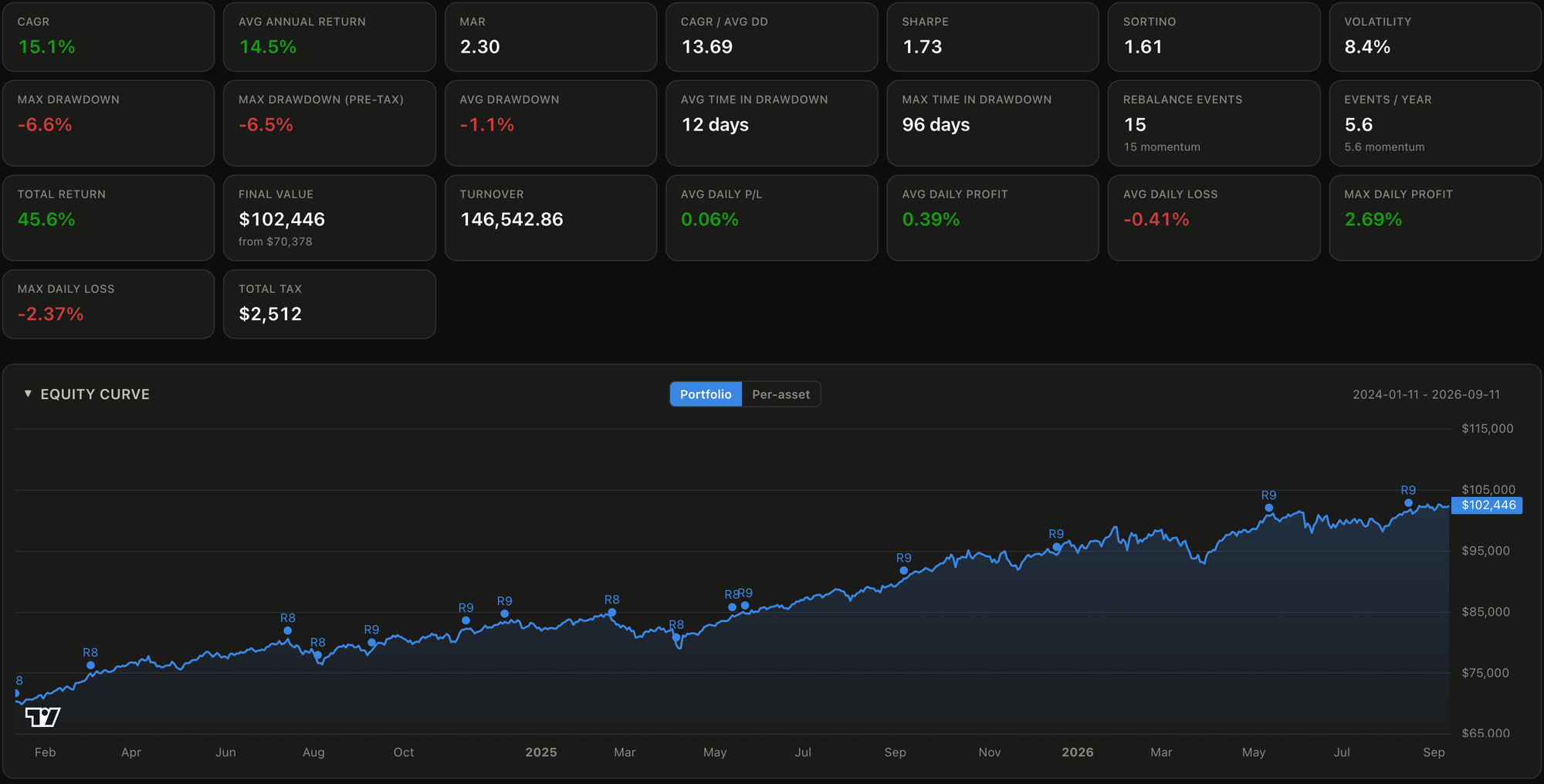
Here is another backtest in which I removed the newer ETFs to show performance over a longer window (since 28/12/2022 - RSST's allocation merged into DBMF; IBIT and CAOS dropped):
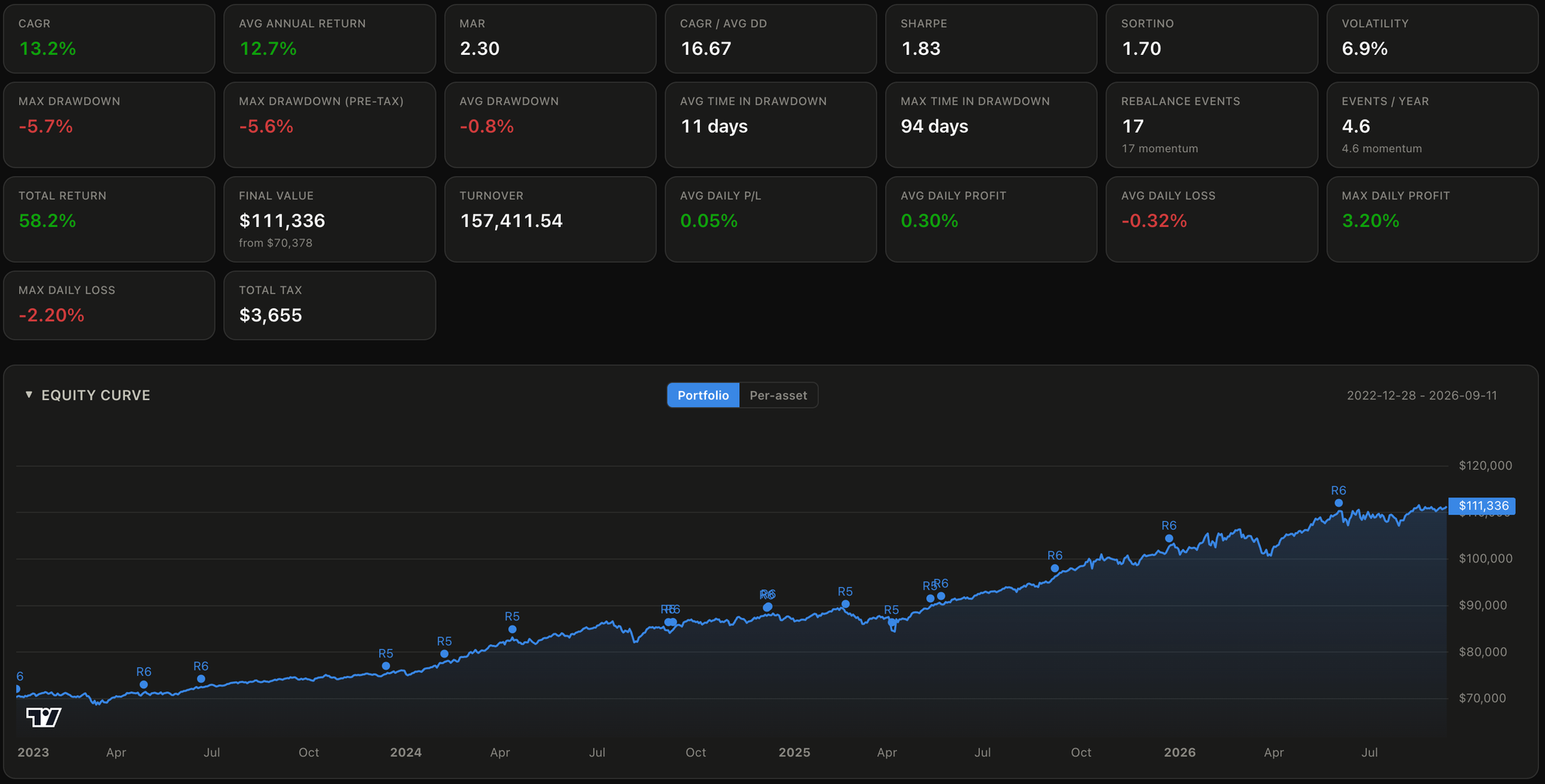
*You might have noticed I have both a "pre-tax" and a "post-tax" max drawdown. This makes it easier to see how tax-efficient I am and what I should expect to keep in my pocket once annual taxes are included. The tax rate used in all backtests is 25% on realized gains (from total sales and distributions).
CAGR also factors in taxes.
Why I Built This
As a trader focused mainly on premium-selling strategies, I wanted my money working while my options trades are running. Most of my trades are credit trades that rely on margin, so there had to be a smarter use for the cash sitting behind them.
Parking free cash in T-Bills (or a similar risk-free-rate asset) was the bare-minimum no-brainer to avoid losing to inflation, but more seemed possible - as long as I kept drawdowns small and manageable, added uncorrelated exposures, and applied smart allocation and rebalancing.
The inspiration came from volatility harvesting (and this video by Mark Anderson): smart rebalancing combined with diversified exposure to volatile, uncorrelated assets - each with a positive long-term expectancy - can produce strong risk-adjusted returns when managed properly.
The basic idea: volatility can be “harvested” into profit with a mechanism that sells assets when they are relatively high and buys them when they are relatively low. Uncorrelated assets drift apart over time, which creates exactly those opportunities - sell what drifted up, buy what drifted down. By design you buy more of beaten-down assets and sell more of inflated ones. That locks in profits when needed, keeps your target exposures in check, lowers your cost basis over time, and amounts to a smarter form of dollar-cost averaging.
The concept appealed to me for several reasons:
- The idea is easy to grasp and light to manage. Even with the bells and whistles I added - momentum buckets, asymmetric ATR-based tolerance bands - it is not a daily task; how often it needs attention depends on rebalancing sensitivity and scheduling
- It is tax efficient, because it never forces a full exit from an asset. You sell what you need when you need it, so most of the portfolio carries unrealized gains into the next year instead of handing them to taxes
- With sensible sizing, diversification and bands set to each asset’s volatility, both raw and risk-adjusted returns are surprisingly good
- Tolerance bands, rather than blind scheduling, avoid unnecessary slippage, fees and commission friction
Asset Selection and Settings
I wanted a rather large share of the portfolio sitting at the risk-free rate: cash available to “pay” for drawdowns, dry powder for buying the volatile assets low, and lower overall volatility. About 38% goes to BOXX and CAOS.
Risk-Free + Hedge (~44%)
BOXX - Options box spreads are a way to earn the risk-free rate from options. I hold this instead of T-Bills because it pays no distributions, which defers taxes. A no-brainer holding: if I had decided against any adventures, this would be close to 100% of the portfolio, since I sell premium.
CAOS - One of Mark’s hedging recommendations. The ETF does three things: it buys protective OTM SPX puts, sells put spreads to pay for those long puts, and runs box spreads like BOXX (so holding it means technically holding more BOXX under the hood). The stable box-spread returns plus the put-spread premiums are meant to fully pay for the market insurance. If the market rises or stays flat, you shouldn’t bleed cash; if it crashes, you win big. That hedges both my long US equity holdings and the premium selling I run on top of the core portfolio. Combine that with the rebalancing mechanism and you automatically lock in profits when it spikes, easing the portfolio's bleed exactly when you need it.
Cash - While I try to limit this holding as much as I can, something needs to pay for losing options trades on a day to day basis...
Core Exposures (~35%)
Here are the allocations actually carrying this forward:
SPMO - Tracks the S&P 500 Momentum Index. Since inception (~11 years) it has delivered better absolute returns (21% CAGR) and better risk-adjusted returns than SPY on MAR, Sharpe and Sortino. It is the main return driver of my core holdings. While it opened my mind to factor investing in general and sent me to explore other factors, I found it more suitable than the alternatives - and quite correlated to them, which made me pass on diversifying this allocation across other factors like quality or value.
DBMF - Uses a quantitative factor-recognition model to dynamically track the holdings of about 20 prominent managed futures managers in the SG CTA Index, executing long and short positions via liquid futures in equities, fixed income, currencies, and commodities. A strong equity diversifier, particularly during sustained market dislocations: managed futures performed strongly during the 2022 equity/bond selloff, when their ability to short falling markets and follow trends provided meaningful crisis diversification.
RSST - This one is special because it gives two exposures for the price of one: a large-cap US index and managed futures at the same time (100% to each, through smart use of leverage). Because those legs are uncorrelated, the combination also beats the S&P 500 in risk-adjusted terms. As you'd guess, it has roughly 0.5 correlation to each of SPMO and DBMF. I couldn't use it to completely replace DBMF and SPMO, though - the balance between all three gives better risk-adjusted returns than either setup alone.
Complementary Bets (13%)
GLD - Gold is nicely uncorrelated to the market and a well-known hedge when markets decline. Held as a small, rebalanced allocation.
IBIT - Some Bitcoin. Fairly correlated to the overall market, but a small allocation felt like a good long-term bet. I could be wrong - but if the past holds any promise for the future, I'd rather hold a small allocation and be wrong than skip it and be wrong.
Short Vol Swing (5%)
This bucket isn't a real "holding" but a trade allocation for shorting the VIX via SVXY whenever certain VIX levels and VIX term-structure conditions are met. The idea is to short the VIX when the odds are in our favor, since the VIX is mean-reverting. This allocation sits in BOXX as long as the entry conditions haven't triggered.
I won't go too deep into this one, as it isn't directly related to the general idea of this specific post.
Rebalancing: Scheduled vs. Bands
Scheduled rebalance triggers - quarterly or annually, say - are the well-known simple approach, but they have two clear disadvantages:
- They trigger unnecessary rebalance events, paying slippage, commissions and fees when the markets did not move enough to make it worthwhile
- They miss chances to “buy low” or “sell high” when one or more assets move significantly, up or down, between two scheduled events
So I started experimenting with bands (portfoliovisualizer.com has a portfolio backtest feature that supports them). Bands rebalance dynamically, reacting to actual market conditions instead of rebalancing blindly - a more balanced and efficient approach, in my view.
Absolute vs. Relative Bands
There are two main types of bands: absolute and relative.
Absolute bands are based on portfolio size. Set a 5% band on an asset whose target allocation is 30%, and a move above 35% or below 25% triggers a rebalance event.
Relative bands are based on a percentage of the allocation itself. A 5% relative band on a 30% allocation is 1.5% (30%*5%), so a rebalance happens whenever the asset drops below 28.5% or rises above 31.5%.
Relative bands are more useful across a whole portfolio because they scale with the actual holding. Take a very volatile asset like TQQQ at a 2% allocation: an absolute 5% band lets it run to 7% before triggering - far too much volatility risk - and it can never trigger a buy, since the lower edge sits below zero. A 50% relative band instead buys every time the holding shrinks to 1% and sells whenever it reaches 3%.
The two can be combined, but I found it simpler to use one mechanism per asset, set according to that asset’s volatility and my risk appetite.
Advanced Band Concepts
Portfolio Visualizer covered the foundation of my research, but there was a lot more I wanted to test - so I built my own platform and started adding features to fit my policy.
ATR-Based Bands
What I like in systems is the ability to adapt to market regimes instead of relying on arbitrary numbers that fit some scenarios and not others. I use the (sort of) same idea when selling premium: credit targeting instead of fixed deltas lets the market’s current pricing decide how far OTM the spread opens.
So I added ATR as the baseline for rebalancing, with two inputs: the lookback in days and an ATR multiplier. If an asset’s 14-day ATR is $5, a 3-ATR move is $15. Because the measure is dynamic, the band widens and narrows as that asset’s volatility changes, allowing bigger or smaller moves before a buy or sell triggers.
Asymmetric Bands
Another experiment: what if an asset's buy trigger differs from its sell trigger? For example, I could sell on a 5×ATR(14) move up and buy only on a 10×ATR(14) move down. The sell trigger sits half as far away as the buy trigger, so the position trims itself readily on strength and adds only after a deep drop. Everything else runs symmetric bands. I ended up not using this, but it's nice to be able to experiment with it.
Full vs. Per-Asset Rebalance
When I built the rebalancing engine, one question I wanted to settle was which approach works better long term: bringing only the asset that breached its bands back into line, or triggering a full rebalance across every holding whenever any single asset breaches its bands - even if just one caused the trigger. The results were quite consistent: a full rebalance every time gave better risk-adjusted returns when tested on longer timeframes. It also made intuitive sense, since it forces the portfolio to hold its target exposures so no position grows into too big a bet, while using each trigger as a chance to lower some cost basis and/or lock in some profits.
Bottom Lines
To sum up: there are interesting, time-proven and robust techniques anyone can apply to improve risk-adjusted returns. These are the ones I use:
- Diversification - small- and large-cap US equities have their differences, but when the market collapses they dive together. Real diversification means metals, commodities and different profit streams such as the variance risk premium - holdings that complement each other and don't move together over long periods, especially during stressed times.
- Volatility harvesting (rebalancing) - use simple, strict mechanisms that force you to “buy low” and “sell high”. You will never time the market perfectly, but tending to buy what is beaten down and sell what is inflating keeps you on the safer side long term. Holding uncorrelated assets and following systematic rules also makes it easier mentally. After experimenting with both per-asset rebalancing and full-portfolio rebalancing on each trigger, the full rebalance showed far better risk-adjusted returns with almost no tradeoff in absolute returns.
- Tax efficiency - not a mechanism but an outcome of the rebalancing approach, and a real benefit. You never fully realize profits, so the tax is deferred year after year. For me that means keeping roughly 25% a year that would otherwise go to tax - a huge win that's hard to beat. It lowers the CAGR I need to reach my goals, since the gap between gross and net stays tight year over year.
- Low friction - bands rebalance only when the market moves enough to matter, so you sidestep the slippage, commissions and fees that scheduled rebalancing racks up on trades that were not worth making.
- Responsible Allocation - allocation is king, and one of the few parameters we truly control. We can never control returns, but we can always understand, manage and accept risk. I would never put a large sum into a leveraged asset; knowing that its max drawdown - or even a complete wipeout - costs me 3% at most is what lets me sleep at night. This matters even more because the portfolio serves as my margin baseline: high CAGR is great, but I have to prioritize stable returns over absolute ones so it can absorb both the core drawdowns and those of my (hopefully forever uncorrelated) options strategies.
- A note on margin requirements. Not every asset counts equally as buying power - some assets often carry higher house margin than standard ETFs, and the numbers vary by broker. Check each holding's actual margin haircut before setting allocations. For me this is a non-issue: I never use more than ~13% of the portfolio as margin (currently) at any one time, so the exact haircuts don't move the needle.
Stay safe, and may G-d bless your MARs and Sortinos.
Nothing here is investment advice. This is a description of what I do with my own money, not a recommendation - every asset mentioned can lose value, and you alone are responsible for your own decisions. Do your own research, and consult a licensed financial advisor before acting on anything you read here. Past performance is no guarantee of future results.